My friend LutheranHusker posted a Synod Vision thing over at his place yesterday. It was great. Some really helpful stuff there.
We're going to be heading into a vision process soon, and I like some of the questions the Synod asked LH and others. But one item I've been considering quite often is "authenticity." As in, "we don't try to BE contemporary/traditional/high church/low church/the frozen chosen of Lake Wobegon/people who 'just want to pray for' spiritual revival/what have you - we ARE what God makes us, right here, in many different ways." Sometimes I'm afraid that "visioning" takes us out of "who we are" in favor of "who can we be in order that we get as many people in the door as possible." 'Cause let's face it, the dark side of getting all those people in the door is our attraction to the money all those people will hopefully put in the offering plates. Rich churches are not by definition faithful churches!
Granted, stewardship and evangelism are important parts of being the church. So is being willing to try new things in order that others might feel drawn into a faith community. But the minute we hold up the mirror to ourselves and notice all the new, big, wonderful things we're trying, it becomes more about us and less about God. And that scares me.
This church stuff is messy. Sunday's texts, I think, are far more about identity than morality, but on the surface it sure seems like morality is what people really want today. I don't know what to think about all this, but it certainly has captured my attention over the past 24 hours: I've hardly been able to think about anything else.
05 February 2008
Our Messy Little Lutheran
So, yesterday morning we discovered that crunchy cereal might taste good, but it PLAYS even better:


Everyone says how much Ainsley looks like her Daddy. Who knew she also shared my preference for coffee?
 relax, folks - the mug was empty when she grabbed it...
At least we know she's Lutheran and she is, indeed, my daughter. But, hopefully, she'll never grow up to look like this:

And that's the latest pictures of our life in Ames...
04 February 2008

Duma Key and the Monday Morning Playing With The Kid iTunes Shuffle

I'll admit to being a HUGE Stephen King fan - have been ever since I read Cujo in 4th grade (yep, you read that right...). But even with the admittedly familiar elements of this book (traumatic accident creates vast alienation for protagonist, who fills the void with creepy pursuits that he doesn't immediately realize are supernatural; see Bag of Bones and Lisey's Story for past attempts at this story), Duma Key is the scariest novel I've read in quite a while. As I was finishing it Friday and Saturday night, the story creeped me out enough that the noises our cats made after I went to bed made me get up and check to make sure it was only the cats making all the noise. That, folks, is the sign of a good, scary, fascinating read. As usual, the strong characters that King weaves out of thin air make you wish you knew them in real life, especially Edgar, the main character, Wireman, his new best friend, and Jack, Edgar's assistant. And a series of interludes on the nature of creativity, as one book critic noted, is a great window into King's own creative process. All in all, it was a great break from Bleak House for me - and now, back to Dickens and Jarndyce and Jarndyce.
So, then, here's the iTunes shuffle:
1. "Happy Go Lucky Local" - Wynton Marsalis and the Lincoln Center Jazz Orchestra, Live in Swing City - Swingin' with Duke
2. "The Ladies In Town All Know My Name" - Strong Bad, Strong Bad Sings and Other Type Hits
3. "Minas Morgul" - Howard Shore, The Lord of the Rings: The Return of the King
4. "Standin' Round Crying" - Eric Clapton, From the Cradle
5. "New Love" - Chris Cunningham, House Concert
6. "Pull" - Justin Roth, Shine
7. "Tennessee Stud" - The Chieftains, Down the Old Plank Road: The Nashville Sessions
8. "Bigger Than My Body" - John Mayer, Heavier Things
9. "Uranus, the Magician" - Gustav Holst, performed by the Chicago Symphony Orchestra, James Levine, Cond., Holst: The Planets (stop that snickering...)
10. "Another Time" - Storyhill, This Side of Lost
11. "Tight Rope" - Stevie Ray Vaughan & Double Trouble, Greatest Hits
12. "There's Always One More Time" - Harry Connick, Jr., 30
13. "Cottontail" - Wynton Marsalis & the Lincoln Center Jazz Orchestra, Live in Swing City - Swingin' with Duke
14. "Interlude" - Igor Stravinsky, The Composer (Robert Craft; the orchestra of St. Luke's)
15. "Finale" - The Chieftains, Live from Dublin - A Tribute to Derek Bell
16. "Rondeau" - Canadian Brass, Fireworks! (Baroque Brass Favorites)
17. "Undercurrent Blues" - Benny Goodman, Ken Burns Jazz: Benny Goodman
18. "Out Of My Mind" - John Mayer Trio, Try! [Live]
19. "Bona & Paul" - Wynton Marsalis, Standard Time, Volume 3: The Resolution of Romance
20. "Looking Back" - Nat King Cole, The Very Best of Nat King Cole
The Painting Project, or Why I Haven't Been Blogging Much Lately
Last weekend was the big push to get our bedroom and the bathroom in our new house repainted before the carpet was installed. As you may remember from my Facebook page, here's what we started with:

Middle Bro and I started Saturday morning by scoring that lovely border and spraying the heck out of it with that wallpaper-remover stuff. We had most all of it cleared away by lunchtime, by which time Kristin's sister and her family had also arrived. After a hearty sandwich and chips lunch we finished taping and started priming:


After the primer dried, we started on the walls - a nice brown for three, and a vibrant cranberry as an accent. Here's the first coat going on:


We finished everything but the third coat of the cranberry and the trimming by Sunday afternoon. Monday night and Tuesday morning I finished things up, completing the cranberry trimwork just before the carpet installers got to work. Here is the finished product:


All in all, I'm really happy how things turned out. Hopefully all our projects will go this well!
03 February 2008
Sermon for the Transfiguration of our Lord - "On Time and Waiting"
When I was much, much younger, the highlight of my summer was the 4th of July. Baseball is a big deal in my hometown, and the 4th was the biggest night of the summer between the end of school and the start of the state playoffs. We played the next town over every 4th of July, and it was always an entertaining game. But what made the 4th of July extra special for me, like many other boys under the age of 15, was the fireworks show.
It seemed like darkness would never come on those magical 4th of July nights when I was a kid. The game would get over and the lights would go out, but there was still that glimmer of dusk in the air and so we’d wait. We’d wait and we’d wait and we’d wait, until, finally, the first flash of light would pop over the outfield fence, and we knew that everything for which we’d waited had finally come.
Why did we have to wait, on those summer nights when I was a kid? It was a question of time. We waited because the time wasn’t yet quite right for the fireworks show. The people running the show knew that the flash and sparkle of the fireworks would be at their height if they waited until the time was right, when darkness had descended and the audience would be even more impressed by the grandeur of the show. So we waited, until the time was right for things to come to pass.
Waiting is something not many of us know how to handle. There’s an internet commercial going around about the Slowskys, a family of turtles who prefer waiting for their dial-up service rather than having the instant response of broadband. It’s satire, of course: doesn’t everyone want faster downloads and better response time from their computer? After a 15 year hiatus, Domino’s reinstated their 30 minute pizza delivery process last year. But in our reading from Exodus today, we hear how Moses waited. And waited. And waited. Seven days on the mountaintop, and we have to ask ourselves: what was the point of all that waiting? What happens with all that time?
There’s an ancient Celtic belief in “thin places;” places where the world we know comes into close proximity with the eternal. I think that any place can be a “thin place” if God chooses it to be so, and that waiting has something to do with that. I believe that Moses was called onto the mountaintop to wait so that when God’s glory came near, the full impact would be made upon him. I believe that sometimes God lets time run until the time is right for the eternal to come near, and that in the places where that happens the waiting and the experience combine to allow incarnation to happen, the eternal reshaping the temporal into a closer approximation of the image in which it was first created. And I believe you and I know these times when they happen – we just don’t always think God has anything to do with it.
I remember taking a walk with Kristin on a snowy afternoon a few weeks after we started dating – that walk seemed to last for hours, but at the same time, when it was over, it was like we’d just left the coffee shop where it started. I had the same feeling the day Ainsley was born. Yesterday morning I had coffee with Dave Krumm, our board president; he shared the story of catching an 8 pound trout in a lake in
The ancient Greeks had two words for time: chronos and kairos. Chronos is watch time, appointment time, bus schedule time. Chronos is measured in units, from nanoseconds to millennia, but the units are set and do not change. A minute is a minute is a minute. The world record in the mile is held by Hicham El Guerroj of
These moments when Kairos and Chronos combine are the moments when incarnation happens. The word we translate as “glory” in Hebrew is dbok;. It literally means weighty, heavy – the Latin word would be gravitas – wholeness & immensity. In a world filled with frivolity and meaninglessness, God’s presence can be unbearably demanding and even harsh, but it also is uncontrollable, unpredictable, utterly worth the wait. To be brought into the presence of God, the very power of all eternity, is transformational – you can never be the same again. These are moments that transform the rest of your life.
When the full dbok; of Jesus was revealed to Peter, James and John on the mountaintop, though, it was more than those three disciples who were changed. The whole world was changed by the Transfiguration of our Lord, because those three disciples became the tellers of the story, those who were changed by their kairos moment with Jesus and couldn’t keep it to themselves. But even kairos can take a little chronos to come to full impact. Jesus asked them to wait to reveal what they’d seen, because sometimes God uses chronos time to let those kairos moments mature into the live-giving faith they would need to speak clearly about what they had seen and who they believed Jesus really was and is and will be.
So the questions for us rise up today. What am I waiting for in my faith? Do I trust God when changes don’t happen instantly? Have I learned to remain in the presence of God while God is silent? Do I take God’s silence as an opportunity to practice the faith I’ve been given? Is God transforming me in the waiting time as well, or only in the immediate moment of God’s glorious presence? I think that kairos is what will help us learn to answer these questions – not with absolutely certain knowledge, but with the hope and trust that simply asking the questions means we’re on the way of following Jesus. In the early church, people went through a three year period of teaching called “catechesis” before they were baptized; it’s where we get our modern word “catechism” and it is the root of what we call “Confirmation.” It takes TIME for God to transform us, both chronological time and kairotic time, thin time, where God steps into our world and the dbok; and gravitas of God’s presence transforms us into something new.
But this isn’t always the easiest thing to bear. In fact, sometimes it seems like our church doesn’t WANT transformation, doesn’t WANT the true presence of God, BECAUSE of the power and weight and gravitas that presence brings. Writer Annie Dillard once wrote: “Does anyone have the foggiest idea of what sort of power we so blithely invoke? Or, as I suspect, does no one believe a word of it? The churches are children playing on the floor with their chemistry sets, mixing up a batch of TNT to kill a Sunday morning. It is madness to wear ladies' straw hats and velvet hats to church; we should all be wearing crash helmets! Ushers should issue life preservers and signal flares; they should lash us to our pews! For the sleeping God may awake someday and take offense, or the waking God may draw us to where we can never return.”[1]
This is that the Transfiguration of our Lord means: when God’s kairotic presence invades our chronological world, whether we are waiting or caught up in a moment unprepared, nothing is ever the same. Were it not for the love of Jesus, the presence of God would be more powerful than we could bear. But look at the end of our gospel text today. Jesus touches his beloved disciples and says, “Get up, and do not be afraid.” The touch of Jesus reassures and calms the fears of the ones caught up in the dbok; of God’s presence. In Jesus, God is both overwhelming, immeasurable gravity and serene, kind reassurance. This is time worth waiting for. This is a Savior worth every moment we have. This is glory worth worshiping. Amen.
02 February 2008
YOU GOTTA GOTTA GOTTA GOTTA SEE THIS MOVIE
We watched the movie "Once" last night. Oh, man, it's just too good for words. Here's a video clip with the best song from the movie.
Go out to your nearest video store and rent it NOW. The language is a bit rough in bits, but it is SO worth it!
Go out to your nearest video store and rent it NOW. The language is a bit rough in bits, but it is SO worth it!
01 February 2008
The Friday Five: Options Edition

Sally has the Friday Five for RevGals & Pals today:
There is so much going on this weekend that I thought I'd provide an options Friday 5!!!!Okay, first, the Super Bowl (note the spelling correction):
First Superbowl ( someone explain to this Brit the significance)- love it or hate it?5 reasons please!!!!!
Second, Candlemas/ Imbloc/ Groundhog day/ St Brigid's day- all of these fall on either the 1st or 2nd February.
1. Do you celebrate one or more of these?
2. How?
3. Is this a bit of fun or deeply significant?
4. Are festivals/ Saints days important to you?
5.Name your favourite Saints day/ celebration.
Bonus- 2nd Feburary is also my Birthday- I will donate £1.00 for every comment on my Friday Five Post to the Methodist Relief and Development Fund.
1. It's the epitome of 21st Century American sport - flash and brutality combined. Used to be the World Series, but we're not the same country we were 50 years ago. It's no coincidence that American football uses military terms like "blitz," "attack" and "protection." Where do you think "shock and awe" comes from?
2. The showbiz aspect of the event cannot be overemphasized. The majority of Americans can't even afford tickets to the game, but it's still a sellout every time. The game itself matters little - it's all show, baby.
3. Commercials, commercials, commercials. Again, it's the glitter and the show that matters.
4. Halftime? A chance to see if artists can still rock (Prince, U2, Aerosmith) or if they flop (Paul McCartney, Janet Jackson before the infamous malfunction).
5. There are some of us who actually love football - we watch because it's the last game we'll get to see until August.
Now, as to saints' days, etc. I hadn't heard of Imbolc until you mentioned it today, Sally, though I had heard the name Candlemas but had no idea what it signified. Needless to say, it's not a high day on the Johnson family calendar. Neither is Groundhog Day - seems like the oddest little "holiday" I know. For my money, the best thing about Groundhog Day is the movie of the same name starring Bill Murray.
I do have some interest in Celtic and Irish festivals, just because the culture fascinates me - so mark me down on the "bit of fun" side of things. There is some concern for me about idolatry, but no more so than for my love of Tolkien - the artistic, ethical and moral truths behind the stories are what draws me to these myths and legends, while faith in the triune God is what gives me life itself.
Our American Lutheran church doesn't celebrate many saints' days, though there are some pockets of "high church" Lutheranism around the country who do celebrate them in many different ways. For Lutherans, the most celebrated festival day would be Reformation Day, 31 October (yes, All Saints' Eve), which is the day we believe Martin Luther first posted the 95 Theses on the door of the Castle Church in Wittenberg, Saxony in 1517. Lots of us love to "do it up" for Reformation Day (or Reformation Sunday, the last Sunday in October each year) - we wear red (represents the Holy Spirit and the martyrs of the church), we sing Luther hymns (especially "A Mighty Fortress Is Our God") and we preach about ecclesia reforma semper reformanda - "the church, reformed, is constantly reforming."
We do celebrate other festivals, especially All Saints' Sunday, Pentecost, Holy Trinity and Christ the King. But for Lutherans, Reformation Sunday is a big deal.
Thanks, Sally - this was fun!
31 January 2008
Page 123 Tag
Thanks, Tripp!
The Rules:-
Pick up the nearest book of 123 pages or more. (No cheating!)
Find Page 123.
Find the first 5 sentences.
Post the next 3 sentences.
Tag 5 people.
I'm going to look so much smarter than reality by happy coincidence (what Tolkien would have called eucatastrophe). Here's my play:
I tag Matt, LutherPunk, Hot Cup, Songbird and Church Nerd. Have at it, folks.
The Rules:-
Pick up the nearest book of 123 pages or more. (No cheating!)
Find Page 123.
Find the first 5 sentences.
Post the next 3 sentences.
Tag 5 people.
I'm going to look so much smarter than reality by happy coincidence (what Tolkien would have called eucatastrophe). Here's my play:
Contempt for others makes worship dishonest and deprives it of any divine promise. Individuals as well as church communities who intend to enter God's presence with contemptuous or unreconciled hearts are playing games with an idol. As long as we withhold service and love from a sister or brother, as long as he or she remains a target of our contempt, as long as a sister or brother has something against me or Jesus' community, our offerings will remain unaccepted.Dietrich Bonhoeffer, Discipleship (from which the title of this blog is taken: the German title is Nachfolge or "following after"). The only reason this was the nearest book is that I took the new Stephen King novel, Duma Key, upstairs with me last night. Discipleship then became the nearest book because it was in my backpack when we moved - everything else is still in boxes.
I tag Matt, LutherPunk, Hot Cup, Songbird and Church Nerd. Have at it, folks.
30 January 2008
Sermonating on a Quiet Midwestern Wednesday
Wow, is it ever quiet here today. ONE person has walked through the door since I got to the office at 9:30 this morning: my administrator, stopping in for just a little bit of work she had to finish today. I've read two issues of The Lutheran, last week's Newsweek (still getting forwarded to us from Minnesota), this morning's Des Moines Register, and now for the last two hours I've been working on my sermon for Sunday by reading links at Textweek. I'm hoping to have a manuscript by tomorrow afternoon. Shhhhh, don't tell anybody.
There are some great folks out there posting stuff for sermon reflection. Two of my favorites are Dan Clendenin and Brian Stoffregen. Check them out if you need inspiration and/or thoughtful reflection on the texts for the week.
Speaking of helpful sermon stuff, Luther Seminary has a new preaching site: Working Preacher. Weekly commentary on the three lectionary texts is usually very helpful. Plus, Mark Throntveit, Professor of Old Testament at Luther Seminary, fellow Tolkien nut and self-proclaimed curmudgeon (though I don't think he's actually reached the age at which one can legally use the term self-referentially) has posted a great piece, "New Year's Resolutions for Preachers" .
I've heard this quote from Annie Dillard mentioned several times this week already:
“Does anyone have the foggiest idea of what sort of power we so blithely invoke? Or, as I suspect, does no one believe a word of it? The churches are children playing on the floor with their chemistry sets, mixing up a batch of TNT to kill a Sunday morning. It is madness to wear ladies' straw hats and velvet hats to church; we should all be wearing crash helmets! Ushers should issue life preservers and signal flares; they should lash us to our pews! For the sleeping God may awake someday and take offense, or the waking God may draw us to where we can never return.”[1]
That's good stuff there, too. Put that book on my Amazon wishlist, if anyone's so inclined.
Tonight it's going to get busier here. We'll have choir practice at 8:00, followed by Holden Evening Prayer at 9:00 and pizza at 9:30 (again, campus ministry ROCKS). Will we have even more students in attendance this week, again? Hope so. But at some point the novelty of "the new guy" will wear off, and then I can really get to work.
Our good friend, JZ, who is a Baptist sometime-preacher, church janitor, sometime-mortician, erstwhile middle school English teacher and promoter of Public Television, made us a mix CD before we left for Iowa. He's been known to pass on music occasionally, ever since he discovered that we share a love for U2, Bob Dylan and Johnny Cash. I've been listening to it nonstop in the car ever since - it's a neat collection. Here are a few of the selections:
"Gloria" and "40" by U2 from Under A Blood Red Sky
"The Man Comes Around" and "Personal Jesus" by Johnny Cash from American IV: The Man Comes Around (yes, that last is a remake of the Depeche Mode classic. It's incredible)
"People, Get Ready" by the Blind Boys of Alabama & Robert Randolph
Good stuff, all of it. Thanks, JZ - it was a very thoughtful gift. Well, that's about it for this Wednesday - think I'll call the ladies and see if they want to make a Target run before I have to get ready for worship tonight. We need cat food. Well, the cats need cat food - we just need them to shut up about it. Anyway, I'm gonna get going. See yah.
Peace,
Scott
[1] Dillard, Annie. Teaching a Stone to Talk © 1988, Harper Perennial.
28 January 2008
Our Itty Bitty Helper
The unpacking continues. Actually, we're much further along than these pictures show, but I wanted y'all to see our little helper in action.
First, we had to get her unpacked. Man, those movers will pack ANYTHING! :-)




First, we had to get her unpacked. Man, those movers will pack ANYTHING! :-)


2008 World Man Croquet Championships
This week's entry from the "No, I'm NOT Kidding" department comes from my old college roommate, Coulter, known to friends as "Cousin Eddie." Coulter lives in an undisclosed location in Minnesota, where he has far too much free time on his hands. Thus the following email, which I received a few weeks ago:


Sometimes words just don't do people justice. You rock, Coulter - see you at the ISU game in October. But bring your own beer.
It's once again time for what has become an annual tradition. You are all cordially invited to participate in this invigorating winter activity. For those of you who are unfamiliar with this, it's quite simple. It's exactly like lawn croquet with a few minor variations. First off, we got rid of those wimpy little wooden balls and upsized them to bowling balls. Then since the balls are much heavier, we've discarded the tiny little mallets that were really only good for whacking your kid brother in favor of something a smidge bigger, sledge hammers. We've also replaced the flimsy wire loops with re-bar. And to really make it interesting, we play it on a frozen pond.And just to make sure you believe me, here are the pictures from this year's event:The Man Croquet Championship of the Free World will be held on Saturday, the 19th of January commencing at noon and continuing until it's done, which last year was sometime in the wee hours of Sunday morning. We will be playing once again on the meticulously groomed frozen surface of Lake Libra located at the Libra Ranch, which is just a couple miles west of [Unnamed Minnesota Town]. The address is [Insert Complicated 911 Address Here]. If you require more detailed directions, please ask.
A few other things to note, first off, dress appropriately. It's cold out there. Second, you will need to bring your own beverages. You can also bring along snack items to share as well. Third, be prepared to take penalty shots. We make the rules for these up as we go along. Also new for this year, ice cleats will be allowed and running on the ice will not. Kent can explain why these changes were made if you wish to know.
Hope to see you all there. If for no other reason than just to say that you've seen something new.


Sometimes words just don't do people justice. You rock, Coulter - see you at the ISU game in October. But bring your own beer.
27 January 2008
Sermon for the Third Sunday of Epiphany - "Light in the Darkness"
Those who lived in a land of deep darkness – on them light has come to shine. Repent, for the kingdom of heaven has come near. Let us pray. Father in heaven, you sent your son Jesus as a light for the world, and He has called us to be bearers of that light in our own lives. We cannot create light in ourselves: shine in us. BE the light in us, a light for dark times and dark places. In Jesus’ name we pray. Amen.
In J.R.R. Tolkien’s epic The Lord of the Rings, a few chapters take place in the land of Moria, where dwarves hollowed out an entire mountainside in search of mithril, a light, flexible metal that was stronger than steel. During their time in Moria, the group of travelers is led by Gandalf the wizard, who lights a stone at the top of his staff to provide light in the darkness. Other than that light, all is pitch black as the fellowship of the ring travels three days underneath the mountains. We like to think that life is like this, that good and evil are polar oppsites, that the darkness of which Isaiah speaks is as easily identified as the villain in an old western (the black hat, of course). Truth is, though, it’s not that simple. The darkness that threatens us can be much, much harder to see. In movie terms, I think real life is far more like the movie Thirteen, where the light slowly seeps out of the picture until everything is grey and you can’t tell good from evil anymore. That’s more like the darkness I know. That’s more like the darkness I fear. I think of it in terms like The Great Divorce by C.S. Lewis, where everyone lives in the grey town and nothing has any substance, reality or vitality to it.
Specifically, I fear this darkness of a grey life because I know how easily it can swallow us whole. The battle we fight against it is never-ending and all-encompassing. It takes us in many ways: a gradual de-valuation of the dignity of human life, a refusal to allow any difference of opinion within our government or our society, celebrity worship and a lust for living vicariously through people selling their lives on reality television – all of this, I fear, is creating a world of greyness filled with emotional and spiritual cannibalism. I think this is what causes drug abuse and a host of other problems: we’ve allowed our lives to become emotionally and spiritually empty, and it’s easier to fill them with booze or drugs or sex than it is to fill them with faith, love and service.
I’ve got some personal fears, too. I’m afraid that 10 or 20 years from now I will look back and realize I haven’t been faithful to my calling as a pastor. I’m afraid that I will call attention to myself instead of Christ, that I might become a seller of religious services instead of a servant who listens and invites others to follow Jesus. I’m afraid that I might be missing the point right now.
What’s your darkness? What are your fears? Maybe you’re afraid of disappointing your parents? Maybe you fear the consequences of working to hard to please your parents. Maybe your job is unstable or your career field is shrinking. Maybe you’ve worried about a relationship, or whether you’ll ever have a relationship again. Whatever your fear is, that’s is the land of deep darkness, and whether it’s grey or black, it’s there and it’s real and you know it.
“ The people who sat in darkness have seen a great light, and for those who sat in the region and shadow of death light has dawned.” This is the promise that’s come for us today: Jesus Christ is the light in the darkness, for people in all times and places. He is a light that comes at unexpected times and in unexpected ways, but He comes, friends – have no fear. In our gospel reading today, we read how Jesus came to Peter and Andrew. Peter and Andrew weren’t seeking a teacher – they weren’t on a spiritual pilgrimage – they weren’t looking for a new vision for life – they were at work and Jesus interrupted them. In the midst of a day like any other, Jesus intruded and brought light into their world.
Think of how Peter and Andrew were fishing, and think of it in terms of what Jesus did. Peter and Andrew weren’t fly-fishing or lure-fishing: they were fishing with nets, not lines. Net-fishing involves casting a wide net into the sea, grabbing everything you can and sweeping it out of the ocean into the boat. There’s no bait involved, no lures, no twists of feathers and string to dance and invite fish out of the water into the boat – net-fishing intrudes like light intrudes into darkness. Jesus will not coerce us into the kingdom of heaven, either: he comes like a slap to the head or a net sweeping you out of the sea: “Repent, for the kingdom of heaven has come near!”
In The Great Divorce, a bus comes to the grey town for the people who live there, and they are taken to a place of vibrant colors and intense reality. It is so intense, in fact, that it is painful: the blades of grass are so real that they actually cut the feet of those who live in the grey town. But friends they have known come to them and say that this is a good place, that life is good with such colors and intensity, once you learn how to live in it. As Lewis writes, “Reality is harsh to the feet of shadows.” In the same way, when Jesus comes to us it might be painful and harsh at first. The good news is that when Jesus claims us, He claims us as we are, in our present darkness, whatever shade of grey that darkness may take – but He loves us too much to leave us in our shades of grey. We will be changed, transformed into something new, something vibrant, something more real than we had been before. We will become those who fish for others – transformed through the power of the Holy Spirit into children of the light.
The light of Christ comes for two reasons: to claim us as its own and to transform us into those who fish for others. This is why the church exists, the two core values of the body of Christ. If being transformed and seeking others for transformation aren’t happening for us, then nothing else will matter – we will become a grey church, whistling in the darkness that surrounds us. God has promised a light in the darkness, and God will not have that promise broken by anything, real or imagined, of the devil or of our own sin, death and destruction.
We are children of light, but not because we love the light: we sometimes prefer the darkness, where our sin and evil can remain hidden. We are children of light, but not because we choose the light: we sometimes choose darkness so that our sin may remain concealed. We are children of light, but not because we deserve the light: we deserve our darkness, because we have loved it and chosen it so often. We are children of light because Jesus is the bringer of light, even when the darkness threatens to kill and destroy that light.
In the gospel of John, we hear that Jesus is the light that shines in the darkness, and the darkness has not overcome it. The message of cross, the moment of God’s greatest glory and the most brilliant embodiment of Jesus’ love for us, seems foolish and weak and a scandal to the powers of darkness that threaten us. But to us, who need that light, who cling to the light because it is our only hope, our greatest need, our fairest vision, the cross becomes the very power of God, the light of Christ shining into the darkness to claim us again and again as its own. In our lives, the darkness may appear to win at times. Our fears may overwhelm us. Death will circle us like a lion stalking its prey. Marriages will flounder, careers will end, life will become grey and meaningless and troublesome. But into this darkness Christ will come and offer a simple invitation: “Follow me.” And thus light will shine. For we who live in a land of deep darkness – on us, light has shone, is shining and will shine again. In Jesus Christ, the light and vision of our faith, the kingdom of heaven is coming near. Repent, friends, turn away from your darkness, and follow the light. Amen.
25 January 2008
25th January - A Writer's Almanac Kind of Day
I get The Writer's Almanac from National Public Radio via email every morning. I subscribed in Barrett because radio reception was notoriously poor there - every time we pulled into town most of our favorite stations would go to static. So now I get the WA in my email every morning. It means I don't get to listen to Garrison Keillor read the thing, but I find that's okay; after seven years in Minnesota, you can almost hear him reading it in your head (right up on the mic, breathing through his nose, with his red shoes on, of course).
Today's WA was pretty potent - I had no idea that 25 January was such an important date for writers. The Bard, Robert Burns, the famed Scottish poet; W. Somerset Maugham, a British writer of the early 20th century who is still fairly well-known today, and Virginia Woolf, the great American modernist writer whose classics Mrs. Dalloway and To The Lighthouse changed American fiction forever (and doomed her to forever haunt the halls of sophomore level Literature classes, where she is vilified as one of the most unreadable writers in history by college students too busy to take the time to challenge themselves with good literature. Present writer included, natch) were all born today. Huzzah for writers!
Today's WA was pretty potent - I had no idea that 25 January was such an important date for writers. The Bard, Robert Burns, the famed Scottish poet; W. Somerset Maugham, a British writer of the early 20th century who is still fairly well-known today, and Virginia Woolf, the great American modernist writer whose classics Mrs. Dalloway and To The Lighthouse changed American fiction forever (and doomed her to forever haunt the halls of sophomore level Literature classes, where she is vilified as one of the most unreadable writers in history by college students too busy to take the time to challenge themselves with good literature. Present writer included, natch) were all born today. Huzzah for writers!
24 January 2008
C-c-c-c-lasssss M-m-m-eem-m-me (Sorry, But It's Frigging Cold!)
As in 0 degrees all finking day. The draft from the leaky old windows that flows directly under my desk at the office drove me out into the lounge area for an hour over lunch, just so I could feel my feet again. Now I'm home and it's still pissing cold around here - I can't imagine how bad it must be for my friends back in northwestern Minnesota. Uff da, indeed.
Anyway, LutherPunk posted an interesting meme - not the fun, "gee, isn't this funny" type of meme, but a thought-provoking one. Consider yourself tagged: here we go.
Anyway, LutherPunk posted an interesting meme - not the fun, "gee, isn't this funny" type of meme, but a thought-provoking one. Consider yourself tagged: here we go.
Later addition: From What Privileges Do You Have?, based on an exercise about class and privilege developed by Will Barratt, Meagan Cahill, Angie Carlen, Minnette Huck, Drew Lurker, Stacy Ploskonka at Illinois State University. If you participate in this blog game, they ask that you PLEASE acknowledge their copyright.
Bold the statements that are true.
Bold the statements that are true.
1. Father went to college
2. Father finished college
3. Mother went to college
4. Mother finished college
I'm not sure what program my dad took, but I think it was more of an agriculture certification program, not a degree program.
5. Have any relative who is an attorney, physician, or professor
6. Were the same or higher class than your high school teachers.
7. Had more than 50 books in your childhood home.
Mom & Dad both love to read, and they were in a B00k-of-the-Month club for a while. Lots of Time/Life collections, too.
8. Had more than 500 books in your childhood home. Don't like to read THAT much.
9. Were read children’s books by a parent. All the time.
10. Had lessons of any kind before you turned 18. Piano, guitar, trombone, singing - you name it, it happened, at least for a while.
11. Had more than two kinds of lessons before you turned 18
12. The people in the media who dress and talk like me are portrayed
Not sure what that one's supposed to mean, so we'll leave it alone.
13. Had a credit card with your name on it before you turned 18
14. Your parents (or a trust) paid for the majority of your college costs
15. Your parents (or a trust) paid for all of your college costs
16. Went to a private high school
17. Went to summer camp Five summers - but not East Coast, "gonna be there ALL summer camp, just one week in a sleeping bag in a tent/bunkhouse/covered wagon (yes, that last bit is true; ask any Carol Joy Holling camper from the mid-80s and they can remember the wagons.)
18. Had a private tutor before you turned 18.
19. Family vacations involved staying at hotels.
20. Your clothing was all bought new before you turned 18. HA HA HA HA HA HA HA!
21. Your parents bought you a car that was not a hand-me-down from them. BOUGHT me a car? HA HA HA HA HA HA HA!
22. There was original art in your house when you were a child.
23. You and your family lived in a single-family house
24. Your parent(s) owned their own house or apartment before you left home.
25. You had your own room as a child. Well, sort of - we were short one bedroom, so for a year or so I had my own, but Baby Brother and Middle Brother didn't always get along so well, so we switched back after a while.
27. Participated in a SAT/ACT prep course
28. Had your own TV in your room in high school. Carting up the portable black-and-white from the kitchen doesn't count as "your own TV."
29. Owned a mutual fund or IRA in high school or college. Shoot, I STILL don't have "my own" IRA - Beloved and I share one that she started after college.
30. Flew anywhere on a commercial airline before you turned 16. Once, back home to Nebraska from Seattle, and my grandparents flew standby on the way out and drove our car back a few days later. Had an aunt who worked for Northwest in Seattle. We had a layover in Vegas and I remember the slot machines in the airport, like we had entered some bizarre parallel dimension or something.
31. Went on a cruise with your family
32. Went on more than one cruise with your family
33. Your parents took you to museums and art galleries as you grew up. My dad LOVES museums. We went to the Harry Truman museum in Kansas. When I was 12. B.O.R.I.N.G.
34. You were unaware of how much heating bills were for your family. But I knew that heating the house cost money - because every winter I had to help dad stack straw bales around the foundation to keep the house warmer in the wintertime.
I dunno if I'm supposed to learn anything from this, but it does make you think a little more clearly about where you come from. Ainsley will answer this lots differently than I did, and for that I think that I, my parents and our whole family will be grateful.
23 January 2008
Waiting To Sing, To Drink, To Stop Waiting
Psalm 40.1-8
"I waited patiently for the Lord, who stooped to me and heard my cry.
The Lord lifted me out of the desolate pit, out of the miry clay, and set my feet upon a high cliff, making my footing sure.
The Lord put a new song in my mouth, a song of praise to our God; many shall see, and stand in awe, and put their trust in the Lord."
Matthew 9.14-17
Then the disciples of John came to him, saying, ‘Why do we and the Pharisees fast often, but your disciples do not fast?’ And Jesus said to them, ‘The wedding-guests cannot mourn as long as the bridegroom is with them, can they? The days will come when the bridegroom is taken away from them, and then they will fast. No one sews a piece of unshrunk cloth on an old cloak, for the patch pulls away from the cloak, and a worse tear is made. Neither is new wine put into old wineskins; otherwise, the skins burst, and the wine is spilled, and the skins are destroyed; but new wine is put into fresh wineskins, and so both are preserved.’
40
You're familiar with the idea that wine takes a certain amount of time to fully mature. I know that I often struggle with waiting; for a winemaker, who has to wait until just the right time to enjoy a wine at its best, I imagine the wait must be intolerable. How many of us have developed the capacity to wait well? We shuffle from foot to foot in the checkout lane, groan and grumble in traffic, fidget at the doctor's office. My brother and his family, and my sister-in-law and her family, are on their way here for a visit this weekend and we just can't wait to see them in our new home. The snow is keeping us from fully unpacking my tools and shop materials, and it's getting to where we're grumbling about the wait. Even when there are good things in store, when we know the outcome will be something desirable and enjoyable, it's hard to wait in a world of drive-thru meals, automatic payments and instant credit.
Jesus was asked by John's followers, "Why aren't your disciples fasting like everyone else?" The assumption behind the question was that followers of a great teacher would strengthen their faith and their learning by fasting and other "waiting" disciplines. But Jesus wasn't a teacher: he was the Messiah, and fasting in the presence of the Messiah would be akin to fasting during a wedding feast. When the wine is ready, you drink it; when the wedding feast has come, you eat and drink and dance and celebrate; when the Messiah has come, the time for waiting is over and the time for celebration has come.
Jesus said that the days would come when the wedding party will be gone and the time for celebration will be over. I wonder if these days are what he was describing. The Messiah seems distant at best and absent at worst. One celebrity dies tragically young and receives more attention than thousands of children suffering and dying every day in countries around the world. Churches splinter and fall apart for reasons they can no longer remember. God has promised us a new song, but how long until we will be able to sing it? How long until the song will be heard?
Here, in this moment, God answers the prayer: NOW. Now is the moment to sing. Now is the moment to let the new song sound forth. It may not seem like the right moment, but the moment is not what matters: the song is what matters. Even if the song is a question, like "How long?", the fact that we're singing at all says something about the God who created us and in whom we trust. Earlier in Matthew's gospel, Jesus told his followers, "You are the light of the world...let your light shine before others, so that they may see your good works and glorify your Father in heaven." Here, now, in this present darkness, our song is the light God has given us. When Jesus is present, that is the moment to sing, regardless of what that moment might look like to the world around us, because the song has the power to change the world, to bring light into darkness.
In the movie Sideways, Paul Giamatti's character, Miles, is a dedicated wine snob who's been holding a bottle of Pinot Noir for years, waiting for the absolutely perfect moment to enjoy it. When that moment comes, it's not what any wine drinker would expect - but what matters is that the wine is ready, the moment has come, the song must be sung, so to speak: so Miles drinks his Pinot Noir and he is changed, forever. For us, who ask God, "how long?", the answer returns: "Now. Sing now - and see how the world may be changed, how you might be changed, through My song, My new wine, My love." It's time to sing, friends. Amen.
"I waited patiently for the Lord, who stooped to me and heard my cry.
The Lord lifted me out of the desolate pit, out of the miry clay, and set my feet upon a high cliff, making my footing sure.
The Lord put a new song in my mouth, a song of praise to our God; many shall see, and stand in awe, and put their trust in the Lord."
Matthew 9.14-17
Then the disciples of John came to him, saying, ‘Why do we and the Pharisees fast often, but your disciples do not fast?’ And Jesus said to them, ‘The wedding-guests cannot mourn as long as the bridegroom is with them, can they? The days will come when the bridegroom is taken away from them, and then they will fast. No one sews a piece of unshrunk cloth on an old cloak, for the patch pulls away from the cloak, and a worse tear is made. Neither is new wine put into old wineskins; otherwise, the skins burst, and the wine is spilled, and the skins are destroyed; but new wine is put into fresh wineskins, and so both are preserved.’
40
I waited patiently for the Lord.
He inclined and heard my cry.
He brought me up out of the pit
Out of the miry clay.
I will sing, sing a new song.
I will sing, sing a new song.
How long to sing this song?
How long to sing this song?
How long, how long, how long
How long to sing this song?
You set my feet upon a rock
And made my footsteps firm.
Many will see, many will see and hear.
I will sing, sing a new song.
I will sing, sing a new song
I will sing, sing a new song.
I will sing, sing a new song
How long to sing this song?
How long to sing this song?
How long to sing this song?
How long to sing this song?
You're familiar with the idea that wine takes a certain amount of time to fully mature. I know that I often struggle with waiting; for a winemaker, who has to wait until just the right time to enjoy a wine at its best, I imagine the wait must be intolerable. How many of us have developed the capacity to wait well? We shuffle from foot to foot in the checkout lane, groan and grumble in traffic, fidget at the doctor's office. My brother and his family, and my sister-in-law and her family, are on their way here for a visit this weekend and we just can't wait to see them in our new home. The snow is keeping us from fully unpacking my tools and shop materials, and it's getting to where we're grumbling about the wait. Even when there are good things in store, when we know the outcome will be something desirable and enjoyable, it's hard to wait in a world of drive-thru meals, automatic payments and instant credit.
Jesus was asked by John's followers, "Why aren't your disciples fasting like everyone else?" The assumption behind the question was that followers of a great teacher would strengthen their faith and their learning by fasting and other "waiting" disciplines. But Jesus wasn't a teacher: he was the Messiah, and fasting in the presence of the Messiah would be akin to fasting during a wedding feast. When the wine is ready, you drink it; when the wedding feast has come, you eat and drink and dance and celebrate; when the Messiah has come, the time for waiting is over and the time for celebration has come.
Jesus said that the days would come when the wedding party will be gone and the time for celebration will be over. I wonder if these days are what he was describing. The Messiah seems distant at best and absent at worst. One celebrity dies tragically young and receives more attention than thousands of children suffering and dying every day in countries around the world. Churches splinter and fall apart for reasons they can no longer remember. God has promised us a new song, but how long until we will be able to sing it? How long until the song will be heard?
Here, in this moment, God answers the prayer: NOW. Now is the moment to sing. Now is the moment to let the new song sound forth. It may not seem like the right moment, but the moment is not what matters: the song is what matters. Even if the song is a question, like "How long?", the fact that we're singing at all says something about the God who created us and in whom we trust. Earlier in Matthew's gospel, Jesus told his followers, "You are the light of the world...let your light shine before others, so that they may see your good works and glorify your Father in heaven." Here, now, in this present darkness, our song is the light God has given us. When Jesus is present, that is the moment to sing, regardless of what that moment might look like to the world around us, because the song has the power to change the world, to bring light into darkness.
In the movie Sideways, Paul Giamatti's character, Miles, is a dedicated wine snob who's been holding a bottle of Pinot Noir for years, waiting for the absolutely perfect moment to enjoy it. When that moment comes, it's not what any wine drinker would expect - but what matters is that the wine is ready, the moment has come, the song must be sung, so to speak: so Miles drinks his Pinot Noir and he is changed, forever. For us, who ask God, "how long?", the answer returns: "Now. Sing now - and see how the world may be changed, how you might be changed, through My song, My new wine, My love." It's time to sing, friends. Amen.
22 January 2008
Tuesday Lectionary Thoughts
Isaiah 9.1-4
1. "the people who walked in darkness have seen a great light." Light and Epiphany go together like ham & cheese. Peanut butter & bananas. Pretzels & Nutella. 'scuse me a second - I need a snack...
2. One historical reminder from earlier in Isaiah is that Judah found itself under a yoke of oppression because they bought their "freedom" from the Assyrians to protect his reign from Israel and her co-conspirators. (see Second Kings ch. 15-17). God said "do not fear human conspiracy," but Ahaz made self-protective deals and thus sealed the fate of Judah as well.
3. Continuing through Isaiah 9.7 gives us the "Wonderful Counselor" text that is so familiar from Advent readings. Possibly this was kept out of the pericope to keep the focus on Matthew and the "land of Zebulun & Naphtali" connection.
Psalm 27
1. There are a ton of hymns with this psalm at their core - might be a good Sunday to sing the psalm in an entirely different way.
2. 27.13 is not in this year's pericope, though it was in the past. The "land of the living" is the opposite of Sheol, a place of darkness & shadows = God's light intrudes where darkness reigns.
3. This is one of the more poetic psalms - our local text study group spent some time talking about the beauty of what God provides "in the shelter of the sanctuary" (ELW translation), and also the evil that comes when we do evil to one another in the holy place.
First Corinthians 1.10-18
1. Baptism is not Paul's goal (and all the Lutherans gasped in horror) - for Paul, baptism serves as a means for PROCLAMATION. Paul's ministry was focused on the spread of the gospel and the planting of churches, not initiation rites and sacramental theology. There is some evidence that baptism was far more visionary and far less initiatory in the early centuries of the church.
2. I had a note to myself to preach a series involving last week's epistle, this week and next week, since the first chapter of First Corinthians is so potent. Due to the liturgical schedule and our move, I elected not to do it this year, but I might in 2011 (once I convince myself that 2011 is a real date. Sheesh this new millenium bit is a lot to handle sometimes!).
Matthew 4.13-25
1. Ties to John's ministry:
a. there's a chiasm with 3.1-2, where John and Jesus proclaim, but John decreases while Jesus increases.
b. the word used for John's arrest, "paradidomai," is the same word used when Judas "hands over" Jesus at the end of the gospel.
c. In Matthew 14.13, Jesus also withdraws "anachoreo" when John is killed.
2. Ties to Isaiah: Nazareth is in the land of Zebulun, Capernaum is in the land of Naphtali.
3. M. Eugene Boring draws a parallel between the Exodus and Jesus:
Israel = Red Sea birth - Wilderness Wandering - Nation
Jesus = Baptism - Wilderness Temptation - Messianic Community
Big Long Wrap-Up Thought: Fishing with nets is not fly-fishing, and what Jesus does to the disciples, though Norman Maclean suggests otherwise in A River Runs Through It. Fishing with nets is disruptive, intrusive and non-coercive; so, also, is faith that comes through the intrusion of the Holy Spirit. Boring, again, says that Jesus is "not filling a vacuum or meeting an obvious need." I don't know how that fits with modern faith, though - most intrusive forms of evangelism tend to be pretty offensive to me these days. Somehow I think character might be wrapped up in it as well: I'm certainly not Jesus, nor have I met Him face to face, but I have met folks whose faith and discipleship has shaken up my own. Maybe that's the disruptive part of living in the church today.
21 January 2008
Pics of the Birthday Girl
Hard to believe it was a year ago today that we first said hello to our little girl. Here she was, all seven pounds and two ounces of screaming fury that first night:
 AAAAnd here she is today, twenty-some odd pounds of still screaming fury, as we've found out the last two nights about 4:00 a.m. But we had a good moment this morning:
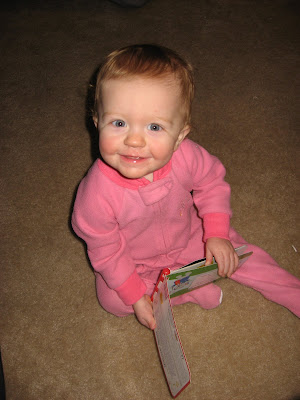
Happy Birthday, Tootie. We didn't get you a present yet because we're going to celebrate with Grandma & Grandpa Johnson and Uncle Brian & Aunt Donna & Zach in a couple of weeks. Grandma Mooneyham was here today, but we needed to take her to the airport, so we didn't even have a cupcake with a candle in it for you. Yeah, we suck. But we love you!
 AAAAnd here she is today, twenty-some odd pounds of still screaming fury, as we've found out the last two nights about 4:00 a.m. But we had a good moment this morning:

Happy Birthday, Tootie. We didn't get you a present yet because we're going to celebrate with Grandma & Grandpa Johnson and Uncle Brian & Aunt Donna & Zach in a couple of weeks. Grandma Mooneyham was here today, but we needed to take her to the airport, so we didn't even have a cupcake with a candle in it for you. Yeah, we suck. But we love you!
20 January 2008
Sermon for the Second Sunday of Epiphany: "Invitation and Information"
Jesus and his disciples were walking along one day when Jesus said to them, “Who do you say that I am?” The disciples answered, “You are the incarnational essence of all that is divine. You are the eschatological in-breaking of God’s future. You are the kerygma through which the world is interpreted. You are the source and ground of all existence.” And Jesus said, “Huh?”[1]
Information is seductive. A friend of mine just got back from a conference on healthy congregations. He said, “when [they] speak of “keys” [to healthy congregations], I get a little lost in "silver bullet" thinking. You know, if we just do these three things, then everyone will come! Yahoo!” [2] We need to know better than this. We need to understand that life is about far more than information – especially in an information-saturated environment like our own.
Here in John’s gospel we see that information is not the only show in town. What gets things rolling in John's gospel is invitation, not information; "Come and see," not "Behold the Lamb of God who takes away the sin of the world!" Both are important. Both are necessary components of the story. Both have their place within our own lives of faith. But the invitation is the catalyst for the information to take root and grow. Let us pray: Lord Jesus Christ, you have found us here, listening to your summons to “Come and see.” Help us to see you rightly, as the One who gave us His life on the cross. Help us to hear you rightly, to remember your promise of love and mercy. Help us to witness to you rightly, to offer the invitation we have received to others: We have found the Messiah – Come and see!” Amen.
So: how did you get here this morning? Let’s share some invitation stories, shall we?
Invitation is more than someone asking you in, or tricking you into coming through the door. Invitation is being made to feel welcome, wanted, part of a larger whole. To be invited into a faith community is to be told that you have something of the image of God within you, something that makes you a part of the body of Christ – and at the same time, to be told you’re not welcome, not invited, is in some ways a denial or rejection of that same image of God. All of this, and much, much more, rises out of these three words from the gospel of John: “Come and see.”
I’d like to share two stories of invitation with you this morning. The first happened when I was a college freshman. It was just after spring break and I hadn’t found any summer employment around my hometown. The prospect of another summer working for my dad on our family farm wasn’t really inspiring for me, but I’d just about run out of options. During the school year I was working in one of the dormitory snack bars, and one night Mike, the boyfriend of one of my coworkers came down for a burger and fries during a study break. He happened to be wearing a staff shirt from Camp Carol Joy Holling, the Lutheran church camp I’d attended when I was a kid. I asked him if he worked for CJH, and he said he had, and that he was planning to return for one last summer that year. I mentioned that I’d always thought that being a counselor there would be fun. Mike said, “Well, we’re still looking for male counselors – why don’t you apply?” He immediately went back to his room, grabbed the program director’s business card and brought it back to me at the snack bar. I called the camp, interviewed the day after I finished my finals, and two weeks later I was in staff training to be a counselor. All because Mike had seized an opportunity to simply offer an invitation. Mike didn’t know me particularly well: we’d never once had a conversation about faith or camp or anything that would have indicated the slightest possibility of my working at camp. But when the moment came, Mike allowed it to happen – he simply offered the invitation and let things go the way God wanted them to go.
The second invitation story I’d like to share with you happened the following summer. Roger, our executive director had been out among the campers that day, and he’d spent several hours at the site where I was working as a counselor. At the end of the evening, after worship was finished and the campers were heading off to bed, Roger threw his arm around my shoulders and asked, “Scott, have you ever considered ministry as a career?” To that point, I hadn’t: I was a dedicated music major with plans to become a band director after college. But once Roger offered the invitation, I couldn’t stop thinking about the ministry as a career. Again, there was nothing to suggest to Roger that the possibility was even there: but Roger sensed something and allowed the Spirit to guide him, to see how God might be at work in that moment in my life and his own. Those two invitations, and many, many more, have made me the person of faith that I am today, and I sense the same is true for you in your own story of faith.
In the body of Christ, invitation doesn’t happen by accident. Turn in your hymnals to page 1162, where you’ll find the Small Catechism. Now look at the bottom of the page, to the explanation of the third article of the Apostle’s Creed. Martin Luther wrote “I believe that by my own understanding or strength I cannot believe in Jesus Christ my Lord or come to him, but instead the Holy Spirit has called me through the gospel, enlightened me with its gifts, made me holy and kept me in the true faith, just as the Spirit calls, gathers, enlightens and makes holy the whole Christian church on earth and keeps it with Jesus Christ in the one common, true faith.”[3] We don’t come to any of this on our own strength or power: it is the power of the Holy Spirit that brings us here, the work of God that invites us here, just as it was the power of the Holy Spirit that brought Andrew and Philip and Nathanael and Peter and all the disciples to Jesus through one simple invitation: “Come and see.”
At the same time, the power that calls us in is the same power that sends us out to invite others to experience the same welcome and belonging that we have experienced. This, also, does not happen by accident. Just as you were called and gathered by the Holy Spirit, not through your own strength or understanding, so you can be the one inviting, calling and gathering others into the same body of Christ, through simple invitations: “What are you looking for? Come and see what I’ve found here in this place!” As you’ve heard from my stories and from your own, it isn’t the information that creates the sense of belonging and desire for community: it is the invitation that makes the information worth knowing and experiencing.
“Once a young student asked [Karl] Barth [perhaps the most influential theologian of the 20th century], if he could sum up what was most important about his life's work and theology in just a few words. The question was posed even with gasps from the audience. Barth just thought for a moment and then smiled, ‘Yes, in the words of a song my mother used to sing me, 'Jesus loves me, this I know, for the Bible tells me so.’” [4] Barth was a scholar whose grasp of the faith and the love of God had revolutionized the Protestant church in the 20th century. Barth was an ardent opponent of the Nazi Party and one of the most courageous voices against Hitler in the 1930s. Yet this giant of theology reminded his listeners that information alone cannot reach the human heart: without the assurance of love, faith cannot grow into the life-altering experience it is meant to be. It has nothing to do with how much we know and everything to do with how much we love and are loved in return. John the Baptist himself knew that this was so: he said, “I came baptizing with water for this reason, that he might be revealed to
Audrey West, a professor at the Lutheran School of Theology in Chicago, said that “Jesus' ministry begins not with a mighty command to silence a demon, as in Mark; nor with a sermon to the crowds who have gathered on a mountain, as in Matthew; and not with a quotation from Isaiah to proclaim his anointing for the year of God's favor, as in Luke, but it begins with a question: "What are you seeking?" What are you looking for? What do you need? It is a question worth wrestling with—as individuals, as congregations, as communities—since our answers will have a great deal to do with what we find as well as with the journey we take to get there. What are you seeking? What motivates you? What is that you really need, not just on the surface, but deep down into the core of your being? What are you looking for?[5] Whatever it is we are looking for, whatever it is we have found here, it came through invitation, through someone being willing to say, “What are you looking for? Come and see what I’ve found!” Be joyful, friends, for the invitation to which you listened today is and invitation that will fill you with love, mercy and grace to meet the week ahead of you. And when the Spirit opens a door for you to offer the same invitation, don’t be afraid to ask, “What are you looking for? Come and see what I’ve found!” As you’ve been invited, so you may invite others, and in that invitation you might find your own faith challenged and strengthened as well. God’s blessings be with you in the week to come. Amen.
[1] This is a great joke that I haven’t told entirely correctly here.
[2] Tripp Hudgins, http://www.anglobaptist.org/blog/
[3] Evangelical Lutheran Worship, © Augsburg Fortress 2006, p. 1162.
[4] Achtemeier, Elizabeth. http://en.wikipedia.org/wiki/Karl_Barth#Quotations
Subscribe to:
Posts (Atom)