Showing posts with label Evangelism. Show all posts

01 May 2014

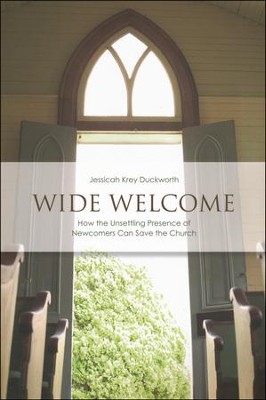
Book Review: Wide Welcome by Jessicah Krey Duckworth

Wide Welcome by Jessicah Krey Duckworth
(c) 2013 by Fortress Press, Minneapolis.
"Congregational life today for many Christians is much more an experience of organizational membership...it usually does not matter what expectations or intuitions newcomers bring to a congregation, because what newcomers encounter is a comfortable, closed gathering in which their presence is not necessarily needed." 
"To be a Christian church is for the people under the cross to practice a confession of faith, hope, and love, welcoming newcomers into discipleship practices where faith meets doubt, hope meets despair, and love meets the suffering world." 
--Jessicah Krey Duckworth, Wide Welcome:  How the Unsettling Presence of Newcomers Can Save the Church,  from the Introduction.

Full confession:  I count Jessicah Krey Duckworth and her husband Chris as friends in addition to being colleagues in ministry, so I was predisposed to think highly of this book before I even cracked the cover.  That having been said, I think Wide Welcome brings a needed and valuable point of view to those of us who are concerned with the future of the church, particularly as the church moves from the age of American Christendom to the emergence of whatever is coming next.

09 June 2011

Evangelizing Ourselves


Sunday night meal at University Lutheran Center


According to some statistics my denomination, the Evangelical Lutheran Church in America, accounts for some 62% of Lutherans in America.  Every year, Iowa State University compiles and distributes the religious affiliation, if any, of its students to their respective denominational campus ministries.  For the 2010-2011 school year, the “Lutheran list” had about 2,500 names on it.  62% of 2500 is 1550, so one could say that as the ELCA campus ministry at Iowa State, we are a “congregation” of 1550 members. 

We average 25 people at worship.  That’s less than 2% of our own young people making worship, much less dedicated membership in a faith community, a priority in their lives.  There is only one way to interpret those numbers:  we, as a whole denomination, have failed, miserably, to live out the vows we make at baptism to nurture the spiritual lives of our young people. 

We are our own mission field.  We are called to evangelize ourselves. 

I love my church.  I love being a Lutheran by birth and by conviction.  I love telling people my church encourages cultivation of mind and spirit.  I love explaining how we believe God’s children are always simul justus et peccator.[1]  I love dropping Luther’s thesis from The Freedom of a Christian:  “A Christian is a perfectly free lord of all, subject to none.  A Christian is a perfectly bound servant of all, subject to all.”  I love being a spiritual descendant of Augustine, Luther, Melanchthon, Bach, Muhlenberg, Kierkegaard, Prenter, Tillich, von Rad, Bonhoeffer, Forde, Marty and many, many others.  I love so many things about my church.  I just wish to God I could love my church for nurturing and cherishing and intriguing and challenging and forgiving and receiving and sending our young people and the families in which they are raised.  But I can’t – because we haven’t. 

I started making notes about this post in a conference hall in Iowa City at the Southeastern Iowa Synod Assembly.  I often make jokes about how much I despise Assemblies, but those jokes are not entirely true.  It’s great to see colleagues and old friends.  I get a chance to tell people about the wonderful work I get to do on campus.  This year, for the first time, I was a co-sponsor of a resolution our Synod considered in assembly.  The ELCA Church Council has proposed a budget for 2012 which includes a 38% cut in churchwide support to campus ministry throughout the denomination.  This proposed cut is far greater than that asked of any other churchwide ministry, and takes the highest percentage of financial support away from the ministry least able to absorb it.  We in campus ministry are currently organizing to attempt to amend the budget so that cuts are equitably shared among the vital ministries of this church.  But regardless of whether our attempt is successful or not, it is becoming abundantly clear that our denomination is divesting, on a national level, from support for ministries to, with and among those between the ages of 18 and 25.  This is why I’m having a hard time loving my church just at the moment.

Churchwide budgets won’t be the answer, however.  Even if we had all the financial support for which we could ask, that would only be one failure averted, and a minor one at that.  The far greater failure is this: our young people and their families are abandoning the church in droves, and we are letting it happen. 

Another example:  as a member of our campus ministry association at Iowa State, I’m one of several religious leaders who staff a table at Resource Fair, where incoming students can meet businesses, service organizations and other community folks they may get to know during their time at the University.  It’s a great chance to meet face to face with students, and to live out the ecumenical nature of what we do on campus.  Yesterday, I had a conversation with a young man who asked about one of our local non-denominational ministries; a friend had invited him to come check it out when he got to campus.  Let’s call him “Alex” (not his real name).  I gave Alex the information he requested and asked him to fill out our information sheet so we could send his contact information to the ministry in question.  When I looked over the info sheet at the end of our day, I noted that in the “Faith Community/Denomination” section, Alex had written “Lutheran.” 

I wish I could say this is an unusual occurrence, but it’s not.  Pastors and families tell me their Alex stories over and over again, and I don’t have a satisfactory answer when they ask “Why?”  What it comes down to is this: we have failed to present a compelling case for our church to Alex and thousands like him.  Alex’s friends evangelized where his own church, his own family, his own faith had not.  Alex’s friends gave him “good news” about their faith community, while we failed to do the same in an even remotely effective manner.  Because of this failure, the chance that he’ll consider campus ministry as a locus for faith formation has become infinitesimally remote, and the difficulty of our calling to tend to his faith is raised a hundredfold.

This crisis in our church is far bigger than campus ministry funding, though I would argue that our Churchwide divestment is a symptom of the crisis.  For the sake of our young people, we must create and nurture communities of compelling, life-changing, authentic, forgiving faith.  We must re-discover why “Lutheran” is a good thing to be, and we must communicate that goodness in everything we say and do.  We must live our faith in such a way that the good news of Jesus Christ becomes infectious in our daily living.  We must accept that our church is, in itself, a mission field in serious need of tending.  In these times, when the attrition of our young people is an epidemic that will take years to cure, we must be about the work of evangelizing ourselves.

[1] Latin, “simultaneously saint and sinner.”

30 September 2010

Exercise Evangelism

I have been having an evangelism experience at the gym lately.

I've struggled with back pain off and on for the past two years, and I'm finally mostly pain-free after well over a year of physical therapy, chiropractic care and essentially taking better care of my body.  About two months ago, I was sharing my struggle with Michelle, our kick-ass spin instructor who has fought cancer and won over the past year (you have no idea what a simpering little weenus you are until you watch a bald woman lead your spin class with a chemo port in her arm).  As we were talking about juggling parenthood, vocations, exercise and all the other important stuff in our lives, she said, "Hey, we've got this new class starting called Centergy - you should give it a shot!  It sounds like it could be just what you need."

My friend Rachel doing yoga at her family's former vacation home in Florida.
Rachel has been pushing me to do yoga for months and will hopefully be happy I'm finally taking her advice (somewhat).
So, last Friday I gave it a whirl.  Centergy is a combination of yoga, pilates and other stuff set to music.  You come in, lay out your mat, and proceed to spend the next hour stretching, working, and sweating.  At least, that's what I did.  It was the weirdest thing:  I never moved more than four feet in any one direction, but by the end of the hour my shirt was drenched and I was in heaven.  Was Michelle ever right - the class worked all the muscles my PT and chiropractor identified as trouble spots for me, and since it was a class where everyone was trying to do the poses, I didn't get that dreaded feeling of "oh, shit, I look like a total fool flopping around on this mat in the weight room."

Tuesday night, Beloved and I both had time free to exercise together, so I suggested we go to another Centergy class.  I had an even better experience than the first, and Beloved liked it as well.  I've pretty much decided that the Tuesday night and Friday afternoon sessions at our gym are going to be added to my regular exercise rotation.

Now, here's where the evangelism part comes in.  Some of my blogger friends have been visiting the topic lately, and I think they've presented some valuable insight.  I think they've covered why we (the ELCA) aren't particularly good at evangelism, but here I'd like to offer some thoughts on how we could be better.

  1. Evangelism addresses the need of the evangelized, not the need of the church.  My friend Michelle wasn't teaching that particular Centergy class, nor was she going to receive a commission if I attended.  She had no thought of her own reward for getting me to sign up:  what she saw was my need for something new and a way our gym could provide it.  Our most effective (and, dare I say, most holy) evangelism comes when our concern is for our neighbor, not our church.  Evangelism driven by the need of the congregation cheapens the gift of the gospel by offering the holy community for the sake of its own benefit, which seems far too much like prostitution for my comfort.  
  2. Effective evangelists listen and hear before speaking.  Michelle didn't break into our conversation with some sort of ham-handed script extolling the benefits of Centergy.  We were talking, as friends, and she heard and understood what I was saying before mentioning the class.  It felt natural and good because it was natural and good.  If the church is to be trustworthy in a post-Christendom environment, it starts by listening to others for the sake of their own story, not that of the church.  Yes, the church has a good story to share, a wonderful story, but the evangelizing moment is not the moment to unload it all on the evangelized.  A simple acknowledgment that "hey, I've heard what you're saying" creates a bond of trust from the very start of the evangelized's relationship with the church - and that trust is essential to the life of the church itself.  
  3. Effective evangelists believe they are offering a real, concrete benefit to the lives of the evangelized.  Again, Michelle didn't suggest the class because it's what she was "supposed" to do:  she offered the class because she thought it could help.  Our gym has a lot of other classes and programs, including a very spendy personal trainer program:  if Michelle's concern was helping the gym's bottom line, she could have done so a hundred times over in the year we've been going to spin class.  But Michelle saw that this class could directly address the very problem I was facing.  Is it so much to ask the same of the church?  Effective evangelists, having heard, offer a benefit that can contribute to the life of the evangelized.  In other words, they don't evangelize because the church needs people:  they evangelize because they believe something in the church can help people in their real, actual, present circumstances.  This is why "Bullhorn Guy" pisses me off:  he doesn't give a fart in a stiff wind about what your problems are now, since if you're hellbound anyway your abusive boyfriend or unemployment or addiction or concern for your kids doesn't matter (and chances are if those things don't matter before you join his church, they won't matter afterwards, either).
There are a few corollaries to these points as well.  First, we who are the church need to understand our role as givers, not receivers.  As Bonhoeffer wrote and others have affirmed, "the church is only the church when it exists for others."[1]  When we use the term "effective" as an after-the-fact descriptor, we emphasize very clearly these are not techniques to develop so much as they are gifts embodied in the act itself.

Second, it is incumbent upon the church to actually offer real, concrete benefit in the here and now.  Life is no longer "nasty, brutish and short;" in fact, for most Americans, life is at the least pleasant, civilized and long.  Any remaining social pressure to join the church in order to be a member of "polite society" is dying a swift death.  These two forces have driven much of what passes for evangelism in the church for the past few centuries.  Now we live in a different world, where God, it seems, is humbling the church in order that it may serve the world in which it is planted.  All of us who read the Sermon on the Mount with a sense of delicious irony may now be realizing, to our horror, that Jesus wasn't being ironic at all.

There is a new reality afoot for the church, especially the mainline American Protestant tradition.  Our comfortable position as the de facto guardians of middle class morality and decency has been pulled from underneath us by a God who "takes by its corners this whole world and shakes us forward and shakes us free." (Rich Mullins)  This new reality may be uncomfortable for a while.  It may even feel like we're dying.  Some of our churches may indeed really die.  But death hasn't been a barrier to stop God in the past - why should the present, and God's future, be any different?

Grace & peace,
Scott 

[1]Bonhoeffer, Dietrich.  Letters and Papers from Prison

08 December 2009

Snow and Shane


Rumor has it that Ames is going to be buried under eighteen feet of snow and ice today and tomorrow. I've been trapping rabbits in the backyard since yesterday afternoon, since it's either that or eat one of the cats when things get really bad.

Just kidding, of course. We DID get our first snow of the year yesterday, and it was lovely. More last night, and our neighbor with the snowthrower cleared our driveway for us - also lovely. And it does look like a pretty good storm is heading our way. Might be a good night for grilled cheese sandwiches and tomato soup.

I'll have another post later today, but I wanted to share this letter from Shane Claiborne that was printed in Esquire. It's been making the rounds on Facebook and other spots, and it's worth the read.

Stay warm, friends!
Scott

19 October 2009

Living Together In Disagreement


We are now nearly two months removed from the 2009 ELCA Churchwide Assembly. Life together continues, even amidst disagreement. But it's interesting how the ELCA's decision to move forward on allowing monogamously partnered gay and lesbian people to serve in rostered ministry pops up in the most interesting places. Saturday night, at the Iowa State -Baylor football game, I was working in the Lutheran Campus Ministry concessions booth when an obviously intoxicated student found out we were the ELCA campus ministry. He was a member of Beta Sigma Psi, the Lutheran fraternity, and amidst the slurred descriptions of how happy he was to find us, he blurted out, "We're not hating on gays here, are we?" After assuring him that the concession stand wasn't the place to "hate on gays," and that, in fact, our campus ministry is an open and affirming ministry, he heaved a sigh of relief and staggered off to find his friends. Or throw up on something. I'm not sure which. *grin*

It just shows how you never, ever know who's watching or what people are thinking about the church. Tonight we'll join the Presbyterian, United Methodist and Roman Catholic campus ministries and the Atheist & Agnostic Association for a conversation about dating at a local coffee shop. You wonder - who might be watching, and what might they think about the church if they overhear us in conversation, disagreeing but not hating on each other? On the one hand, the church doesn't engage in these types of conversations as an evangelism tool, but I can't help but hope someone might be impressed enough to come see what else is happening in a place where we can live in disagreement respectfully.

This morning, the ELCA News Service shared a story of two pastors trying to figure out how to live in our church together. It's worth the read. And have a great day, everyone.

Grace & peace,
Scott

Photo credits: AP Photo/Dawn VIllella

23 September 2008

A New Evangelism Strategy


Okay, hear me out. This comes from a discussion group on Facebook regarding Kelly Fryer's new book, Reclaiming the E Word. Someone used it as an example of effective evangelism and it's so funny and fresh that I think it works.

Of course, what the movie shows is fake, but the end result is EXACTLY the type of reaction for which we should be aiming, right? A faith lived out so boldly, joyfully and publicly that people say to themselves, "I want some of THAT!"

This would look different for all of us - but the point remains the same: never be afraid to live your faith joyfully, loudly, passionately, publicly.

And if it gets a few laughs, so what? :-)